Sunday, February 12, 2012

Thursday, February 2, 2012
Assignment 1 : Federal Territory Day 2012 Theme to transform KL to a better place


KUALA LUMPUR, 28th January – Merdeka Square was the focus of City on Saturday as city folks and visitors to the capital of the nation to watch the parade to mark the launch of te 2012 Federal Territories Day celebration.
Prime Minister Datuk Seri Najib Tun Razak officiated at the ceremony participated by 94 contingents with 8,000 members representing government departments, schools, higher education institutions, corporate bodies, non-government bodies and banks.
Also present at the celebration which started at 8.30am were the prime minister’s wife Datin Seri Rosmah Mansor and Federal Territories and Urban Wellbeing Minister Datuk Raja Nong Chik Raja Zainal Abidin.celebration
includes a procession of antique cars, superbikes and Kuala Lumpur City Hall’s cavalry contingent.
It include discounts on compound, visits to public places, quit rent and fines and free rental for sports facilities and multi-purpose halls and free coupons.
The Information Communications and Culture Ministry organised a programme called Kuala Lumpur Art Street for two days beginning yesterday.
Thirty booths are selling paintings, antiques, used books, old CDs and records, accessories for women and traditional food.
It is highlighted with performances in the form of street music, singing, dancing, clowns, buskers and ‘human statue.

However, the major focus on the celebrations this year, was the theme and the visions that the Mayor had. For KL Mayor Tan Sri Ahmad Fuad Ismail, this year's Federal Territories Day differs from previous celebrations.
Although a lot of activities have been lined up for city folk as in previous years, this year the celebrations had a festival-like atmosphere as it was held on two successive days last weekend. This was to give opportunities not only to KLites but also those from other states to learn what FT Day is all about.
Speaking on this year's FT Day theme "Rakyat Bersatu Wilayah Persekutuan Maju" (Unity for Progressive Federal Territories), he reiterated the need for everyone to work together to achieve this.
"This is our (KL folk) celebration. This is the time when we reflect on what we have achieved as a city and what can be done to improve and it's obvious that we (City Hall) can't do this alone.
"If we are not united, than we will achieve less (than we should).
"On our part, we carry out daily operations including cleanliness and maintenance, but if the people do not appreciate this, then it will be difficult to achieve a better city.
"Then you can see people litter as they please and abuse public facilities, including pedestrian walkways.
“Yes, we run the city by ensuring the upkeep and maintenance of infrastructures, but how do we change people's bad attitudes and behaviour?
"Attitudes like riding a motorcycle on the pedestrian walkway or parking vehicles on it, for instance. Yet people still blame us and simply say that we don't enforce the law when they see this.
"You can blame us for faulty street lights and bad roads as maintaining them is part of our job, but can you blame us for the bad attitude of others?" he asked.
Referring to the Top 20 livable cities vision (KL inspires to be one of them by 2020), he said this also applies to private companies, including contractors and business operators.
Most of the ideas proposed are being carried out, including the basic things that have direct effect and impact on everyone living in the city. These include cleanliness, landscape beautification, road maintenance, flood mitigation projects and pedestrian walkway network.
Fuad wants to get everything in order based on the RM2.3 billion budget for this year. This will not only improve the life of city folk but also the image of the city as part of the efforts to become a livable city by 2020.
The Draft of KL City Plan 2020 is also expected to be gazetted in July.


Wednesday, February 1, 2012
Components of Communication Process

Communication is the process of exchanging verbal and non-verbal messages. It is a continuous process. Prerequisite of communication is a message. This message must be conveyed through some medium to the recipient. It is essential that this message must be understood by the recipient in same terms as intended by the sender. He must respond within a time frame. Thus, communication is a two way process and is incomplete without a feedback from the recipient to the sender on how well the message is understood by him.
 Context may be physical, psychological, social, historical,chronological or cultural. Every communication proceeds with context and is affected by the context in which it takes place. The sender chooses the message to communicate within a context.
Encoder translates thought into verbal & non-verbal messages to decoder

Messages are the information that initiates communication

Medium/Channel is the means for sending a message.

Decoder tries to make sense out of the message and provides feedback

Feedback is the response to a message
There are noises that distort the message in transmission and decoding. Effective communicators take these noises into consideration when they are communicating.
- External noises along the channel of communication are sights, sounds and other stimuli in the environment that draw a recipient’s attention away from what is being communicated.
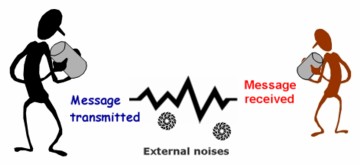
The consequence of external noise is that the message may not reach the recipient in the same form in which it left you (i.e., the message received is NOT the message transmitted).
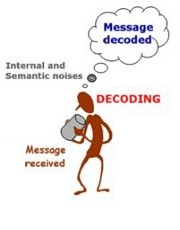
- Moreover, the recipient also has to cope with internal noises. In this case, the internal noises (the recipient's attitude and feelings) interfere with the "decoding" process so much so that the message decoded is NOT the message received.
- Then there are semantic noises, the unintended meanings aroused by certain symbols inhibiting the accuracy of decoding. We need to maintain an empty closet where there are no unsettled grievances in the recipient's mind.